
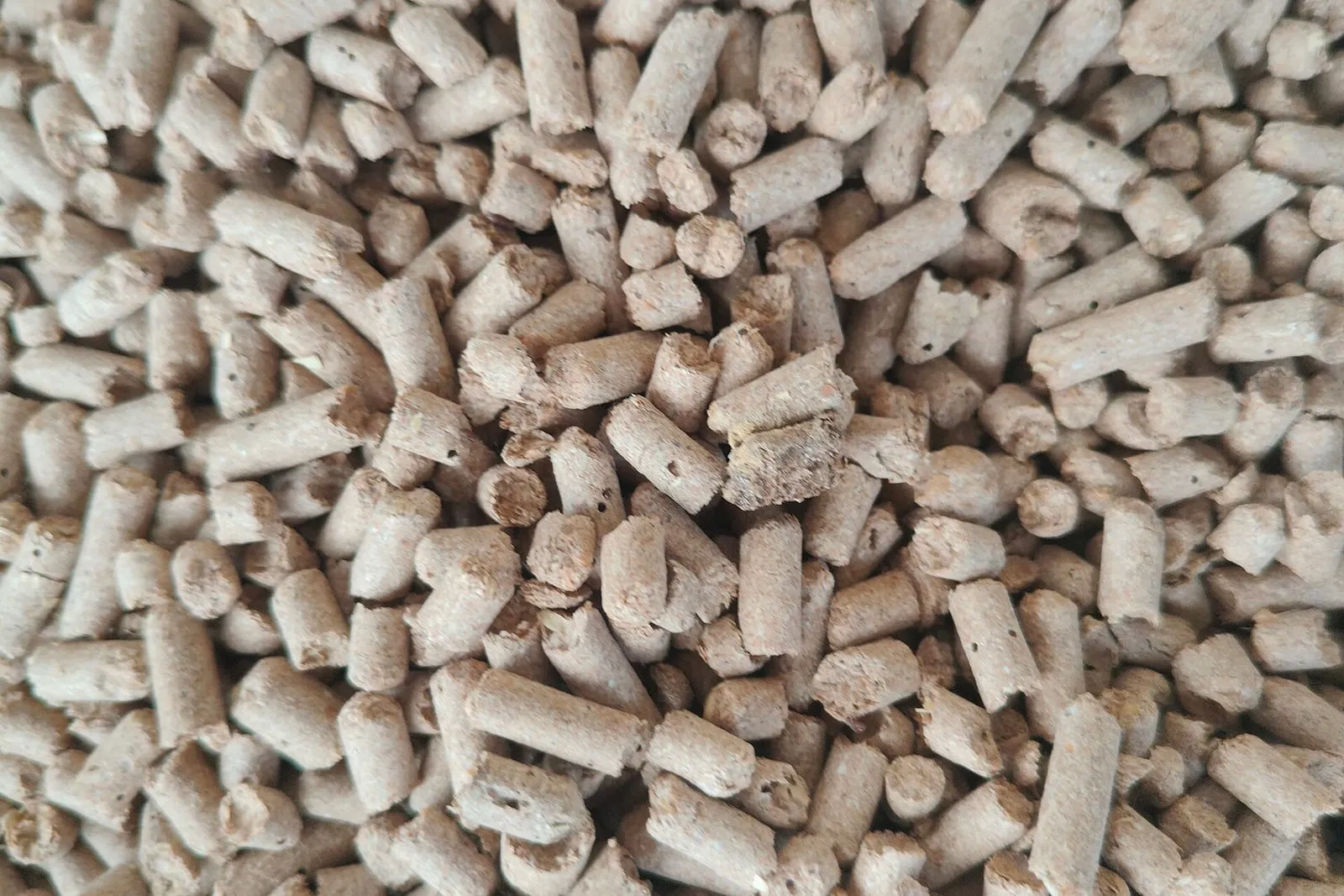

Europe runs on wood pellets to an extent that surprises people outside the trade. They heat apartments in Milan, fire district-heating plants in Stockholm, and feed industrial boilers that once burned coal. The product in all three cases is called a wood pellet, and in all three cases it is a different product.
This guide is a map of that landscape for buyers: the varieties, what the quality classes actually require, how pellets are packaged and moved, and how to check that a certificate claim is real.
It is deliberately broad. Two companion articles go deeper on the parts that deserve it, and are linked where relevant.
Contents
- The European pellet market in outline
- Wood pellet varieties
- Technical specifications by class
- Packaging formats
- Transport, Incoterms and loading
- Certification, and how to verify it
- Wholesale enquiries
- Frequently asked questions
The European pellet market in outline
Pellet demand in Europe splits into four uses that behave like separate markets.
Residential heating — stoves and small boilers in homes, buying bagged pellets through retail and builders’ merchants. Quality-sensitive, seasonal, and the market where certification matters most, because the end user has no laboratory.
Commercial boilers — hotels, schools, greenhouses, workshops. Bigger volumes, often bulk-delivered, usually buying on specification rather than brand.
District heating — municipal networks, particularly in the Nordic and Baltic states. Large contracted volumes with agreed specifications.
Industrial biomass — power generation and co-firing. Enormous volumes, traded on contract specifications that have little to do with retail quality classes.
Geographically, production concentrates where the sawmilling is: Sweden, Finland, Latvia, Lithuania, Estonia, Poland, Germany and Austria all have substantial output, because pellets are made from the by-products of cutting timber. Consumption concentrates where the heating demand and the appliance base are: Italy and France are large residential markets, Germany and Austria combine strong domestic production with strong domestic demand, and Belgium, the Netherlands, Czechia and Romania are significant importers or transit markets.
The practical consequence for a buyer is that pellets travel. A pellet burned in Milan may have been pressed in Latvia. That is why packaging, load planning and documentation matter as much as the specification itself.
Premium residential versus industrial pellets
These are not grades of the same thing. They are different products.
A premium residential pellet is certified to a published standard, made from clean stemwood, low in ash, and sold in sealed bags to a buyer who will never test it. The certification scheme exists precisely because that buyer cannot verify anything themselves.
An industrial pellet is sold on a contract specification negotiated between two technical parties, often with wider tolerances on ash and a different approach to sustainability documentation. The buyer has a laboratory, or pays one.
Confusing the two is a common and expensive mistake. An industrial-grade pellet in a domestic stove will foul it.
Wood pellet varieties
“Variety” means at least three different things in this trade, and they are independent of one another. A pellet has a certification class, a raw material, and a diameter — and knowing one tells you very little about the others.
Certification classes
ENplus A1 — the premium residential class. Clean stemwood, the tightest ash limit of the three, and the class most European stove manufacturers specify in their warranty conditions.
ENplus A2 — a heating class with roughly double the permitted ash. Same energy content. Suitable for boilers designed to tolerate more residue, and generally cheaper to produce because it accepts a wider raw material base.
ENplus B — a certified class permitting up to 2.0% ash and a wider feedstock, including chemically untreated used wood. Intended for commercial installations built for it, not for domestic stoves.
Industrial pellets — not an ENplus class at all. Specification by contract.
Non-certified pellets — pellets sold with a laboratory analysis but no valid certification. These are not automatically bad: a small mill with a good product may simply not have gone through certification. But you are relying on the analysis you were given rather than on an audited chain, and you should price that difference in.
Raw material
Pine — softwood, widely used, resinous, typically good calorific value.
Spruce — softwood, the classic Central European pellet feedstock, generally very low ash.
Mixed softwood — blends of pine, spruce and fir, which is what most volume production actually is.
Hardwood — oak, beech and similar. Denser, often higher ash than clean softwood, and more common in some regional markets than others.
Mixed hardwood and softwood — blended, with characteristics that vary batch to batch. Perfectly legitimate, but ask for the batch analysis rather than assuming last delivery’s figures.
Our own catalogue publishes the stated wood type for each product where the manufacturer declares one — several are stated as fir or softwood, one is a stated mixture of clean wood residues, and one declares no wood type at all.
Diameter
6 mm is the European default for residential appliances. 8 mm appears in larger installations. The standard permits both at ±1 mm. This is an appliance decision — check the boiler manual, not the brochure.
Technical specifications by class
These are the requirements of the ENplus quality classes, which build on the EN ISO 17225-2 standard for graded wood pellets.
| Specification | ENplus A1 | ENplus A2 | ENplus B |
|---|---|---|---|
| Diameter | 6 ± 1 or 8 ± 1 mm | 6 ± 1 or 8 ± 1 mm | 6 ± 1 or 8 ± 1 mm |
| Moisture | ≤ 10% | ≤ 10% | ≤ 10% |
| Ash, dry basis | ≤ 0.7% | ≤ 1.2% | ≤ 2.0% |
| Mechanical durability | ≥ 98.0% | ≥ 97.5% | ≥ 97.5% |
| Bulk density | 600–750 kg/m³ | 600–750 kg/m³ | 600–750 kg/m³ |
| Net calorific value | ≥ 4.6 kWh/kg | ≥ 4.6 kWh/kg | ≥ 4.6 kWh/kg |
These figures describe what the quality classes require. They are not a claim about any particular product. A product only meets them if its own certificate and test data say so — which is the whole point of the verification section below.
The properties behind the table
Length is specified as a range rather than a single figure, because pellets break. Oversized pellets jam augers; that shows up as a service call rather than a quality complaint.
Fines are the dust that has already broken off. Low fines at the mill means little if the product is re-stacked four times before it reaches the burner.
Ash melting behaviour matters more than ash quantity in some appliances. Ash that sinters into clinker at burner temperature causes problems that a low ash percentage alone will not predict.
Chlorine, sulphur and nitrogen are capped because they drive corrosion and emissions. They rarely come up in a retail conversation and matter a great deal in a contracted industrial one.
Moisture is capped at 10% across all three classes. Water in the fuel is energy spent boiling it off — and it is the figure most easily ruined after dispatch, which makes storage and wrapping part of the specification in practice.
For how these properties translate into day-to-day behaviour in an appliance, see our buyer’s guide to choosing premium wood pellets.
Packaging formats
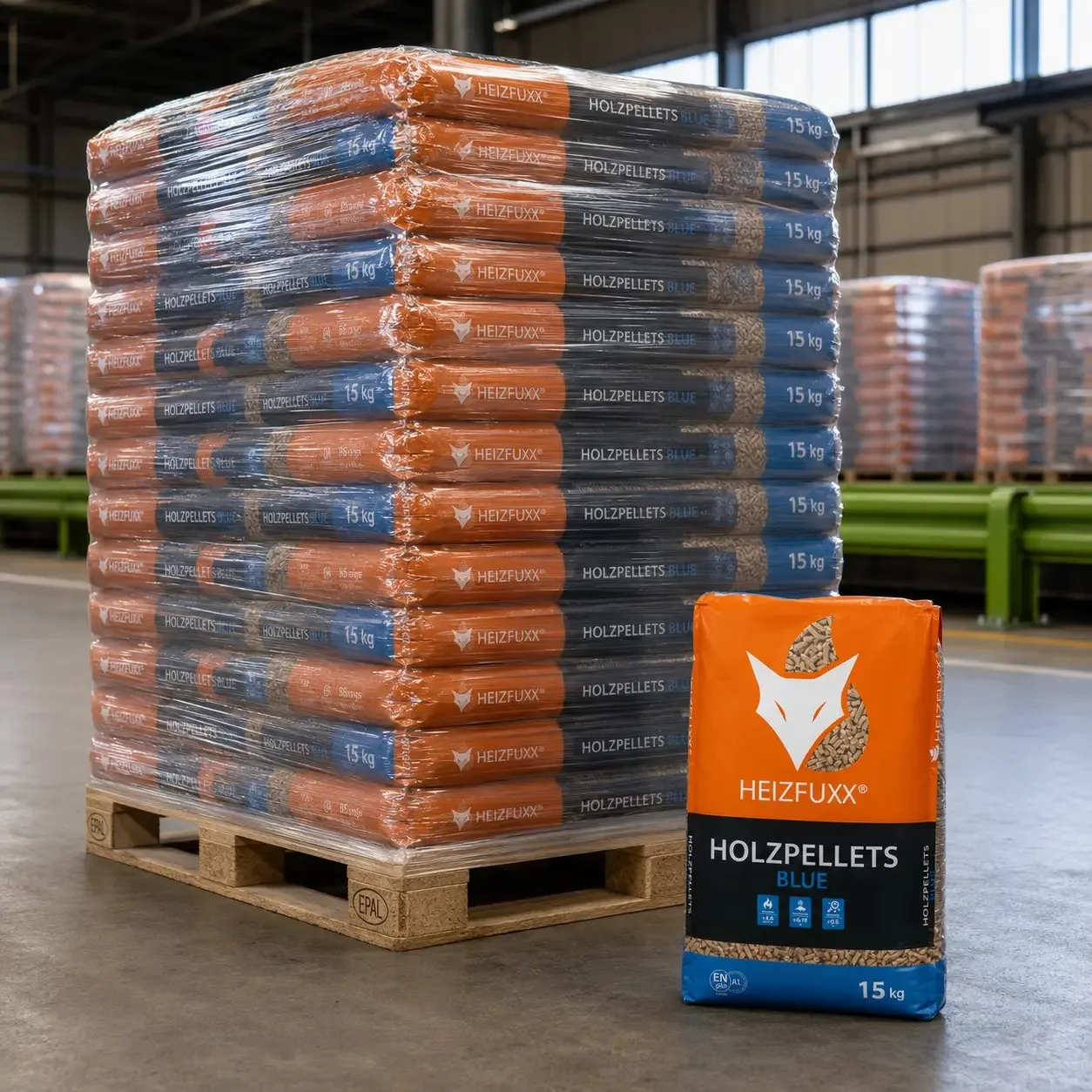
15 kg bags, 65 to a pallet. A product in our catalogue, photographed by the supplier — not an image of a Premium Bio Pellet facility.
15 kg bags
The European retail standard. Printed polyethylene, shrink-wrapped onto a pallet, sold through merchants and garden centres.
Pallet configurations vary by producer, and the variation is not trivial when you are costing a load. Two from our own catalogue: Heizfuxx Holzpellets BLUE at 65 bags per pallet (975 kg) and ScandiWarm Economy at 50 bags (750 kg).
10 kg bags
A smaller consumer format. Easier to carry, sells well in urban retail and to customers without handling equipment, and costs more per tonne in packaging and handling.
20 kg and 25 kg bags
Offered by some producers for commercial and wholesale customers. Fewer units to handle per tonne, but heavier than many retail staff or domestic customers will lift comfortably. A trade-off rather than an upgrade.
500 kg and 1,000 kg big bags
Flexible intermediate bulk containers with lifting loops, handled by forklift or crane. They suit customers who have lifting equipment but no silo, and they reduce packaging waste per tonne considerably.
The actual filled weight depends on the bag’s rating and the producer’s configuration — a “one-tonne” bag is a nominal description, not a guarantee. Confirm the filled weight and the safe working load before planning a load around it.
Loose bulk
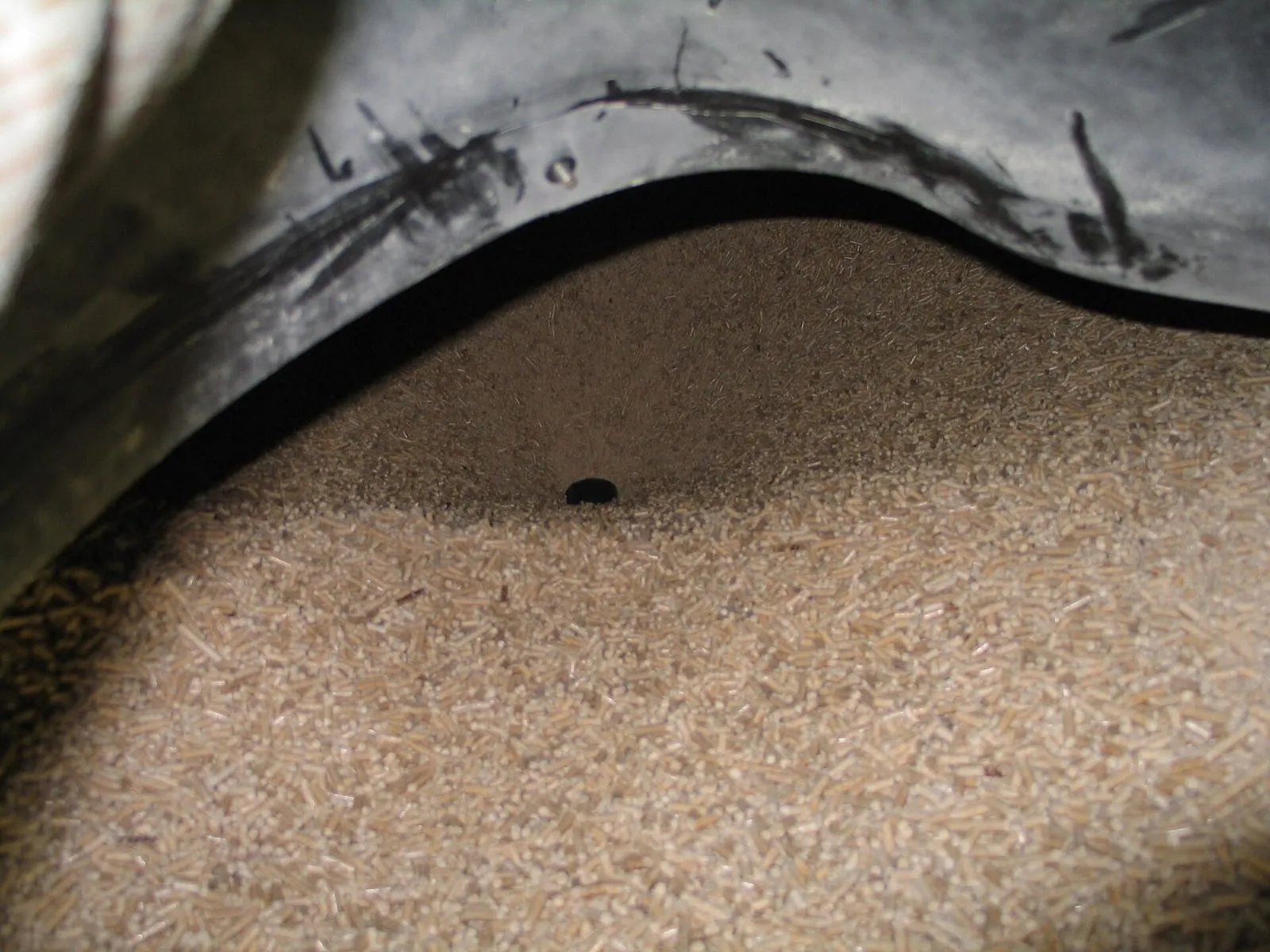
Loose pellets in bulk storage. Note the fines accumulated on the surface — a normal consequence of handling. Photograph: Ralph Oesker, Wikimedia Commons, CC BY-SA 4.0. Illustrative, not a Premium Bio Pellet site.

Unbagged pellets, delivered into a silo or store. The cheapest format per tonne because there is no packaging and minimal handling, and the one that demands the most of the receiving site.
Bulk is delivered by pneumatic silo vehicles that blow the pellets through a hose into a store, by tipping trailers where the receiving pit allows, or by walking-floor trailers for larger industrial deliveries. Pneumatic delivery is the common residential and small-commercial method, and it has a cost: blowing pellets through a hose generates fines, which is why blowing distance and pressure are specified rather than left to the driver.
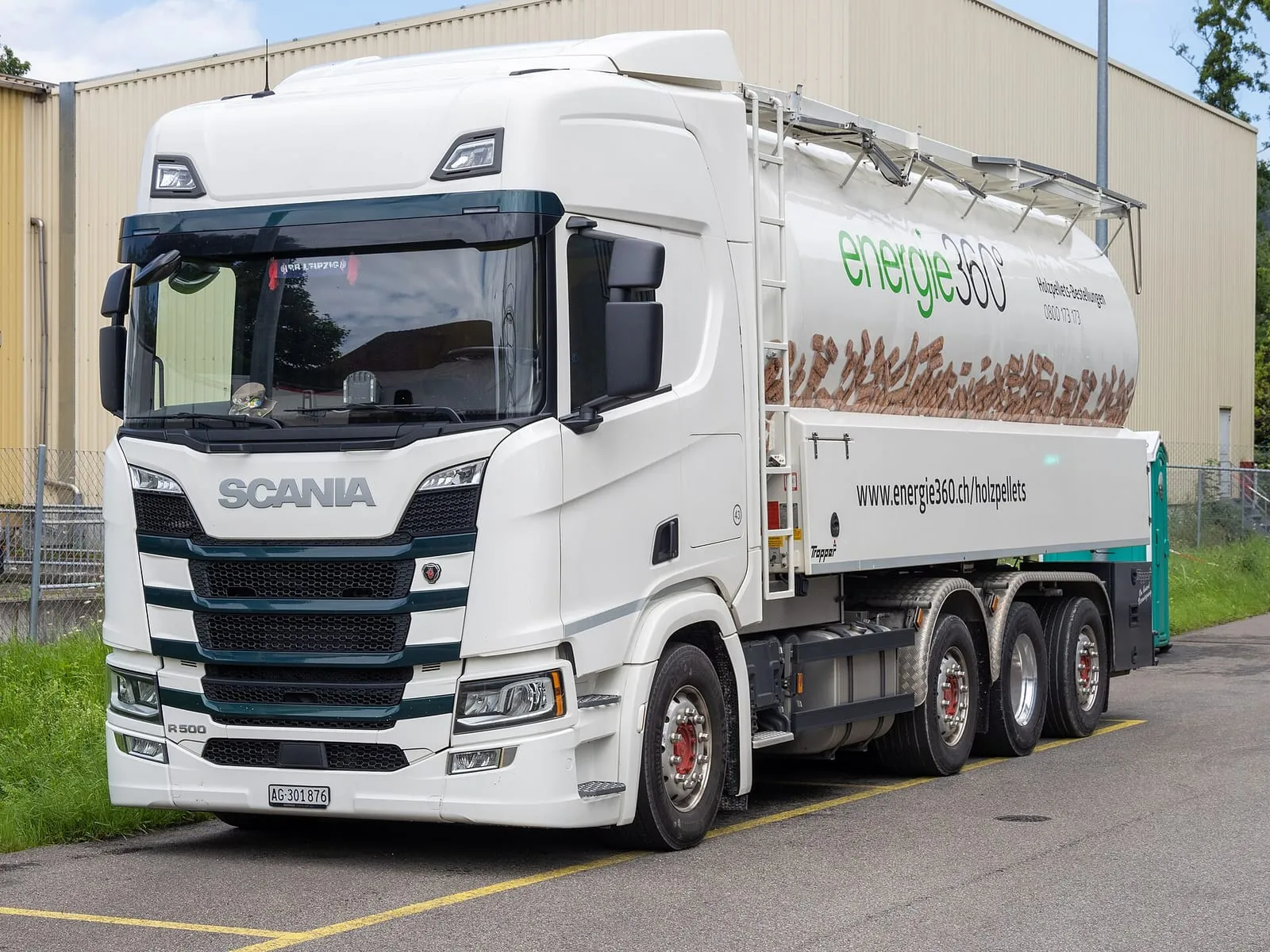
A pneumatic bulk pellet delivery vehicle. Photograph: JoachimKohler-HB, Wikimedia Commons, CC BY-SA 4.0. The vehicle shown belongs to a third party and is not operated by Premium Bio Pellet.

Full truckload, palletised
The format most wholesale buyers actually purchase. Pallets are shrink-wrapped — which is a moisture barrier as well as a handling aid, since pellets are hygroscopic — then strapped and secured for transit.
A standard European articulated combination is capped at 40 tonnes gross under Council Directive 96/53/EC, leaving a payload around 22–24 tonnes depending on vehicle tare. Pellets are dense enough that this limit arrives before the trailer is full.
The arithmetic matters enough that we gave it its own article: how many pallets of wood pellets fit on a truck.
Transport, Incoterms and loading
Who arranges the transport, who pays for it, and where risk passes are three separate questions. Incoterms answer all three in a single term, which is why quotations should always carry one.
EXW — Ex Works. You collect from the seller’s premises. The seller’s obligation ends when the goods are made available. Cheapest headline price, maximum responsibility on you, including loading in practice.
FCA — Free Carrier. The seller delivers to a carrier you nominate, cleared for export. Risk passes at handover. Common and generally fairer than EXW for cross-border trade.
DAP — Delivered at Place. The seller delivers to your named address, not unloaded, with import duties unpaid. The buyer handles customs and unloading.
DDP — Delivered Duty Paid. The seller delivers to your address with everything paid, including import duties. Maximum convenience, highest price, and the seller carries the customs risk.
For intra-EU movements duties are not in play, so DAP and DDP converge in practice — but the unloading obligation still differs, and that is where disputes happen.
A worked load
Take 24 pallets at a gross weight of about 1,000 kg each. That is roughly 24 tonnes, which is at or near the legal payload of a conventional articulated vehicle — so it is a plausible full load, subject to the actual tare of the vehicle assigned. Twenty-four Euro pallets occupy eight rows of three, about 9.6 m of a 13.6 m deck, leaving floor space unused. That is normal for a dense product.
For loose bulk the limit is reached differently: quantity depends on the pellets’ bulk density, the trailer’s volume and the legal weight limit, whichever binds first. At 600–750 kg/m³, a 90 m³ trailer would weigh far more than the law allows if filled, so bulk loads are weight-limited too.
Before the vehicle is booked
Confirm the gross pallet weight, the pallet type and whether it is exchangeable, the pallet height if the load might be double-stacked, and — most often overlooked — what equipment is available at the delivery address. A site with no forklift needs a tail-lift vehicle, and a tail-lift reduces payload.
Certification, and how to verify it
ENplus is the dominant European certification scheme for graded wood pellets. It audits the whole chain — production, trading, bagging — rather than testing a single batch, which is why a certificate number is worth more than a laboratory report alone. It builds on EN ISO 17225-2, the international standard that defines the property classes.
DINplus is a separate German-originated certification covering comparable ground; some producers hold both.
Sustainability documentation is a different axis again. Depending on the destination market and the end use, a buyer may need evidence of the raw material’s origin under schemes such as SBP, FSC or PEFC, or documentation required by national renewable-energy rules. This is contract territory and should be settled before the first order, not after.
How to verify genuine ENplus-certified wood pellets
A logo on a bag is not evidence. Neither is a PDF emailed by the seller. Four steps:
- Ask for the certificate holder’s name and ENplus ID. The ID has a country prefix and a number, such as
DE 123orAT 045. A seller who cannot produce it immediately is a seller who does not have it to hand. - Look that ID up in the official ENplus register of certified companies, published by the European Pellet Council and the national licensers. Check the register, not the brochure.
- Check the status and the dates. Certificates expire and are withdrawn. A number that was valid when the packaging was printed may not be valid now — this is a real and common failure, not a hypothetical one.
- Check the scope and the name. Production and trading are certified separately. A trader’s certificate does not certify the pellets, and a producer’s certificate does not cover a trader who re-bags them. The name on the certificate should match the company you are contracting with.
If an ID is illegible on packaging, treat it as absent until the seller supplies it in writing. Our certifications page explains how we publish the class each product’s own specification declares — including where a product declares none.
Wholesale enquiries
Premium Bio Pellet Sp. z o.o. Grunwaldzka 517C/3, 62-064 Plewiska, Poland
We are a Polish wood-processing and wholesale company. Our registered activities cover the manufacture of sawn and planed wood, the wholesale of timber and solid fuels, warehousing, and road freight transport. Registration details, all verifiable in the Polish public registers, are on our company page.
We handle wholesale enquiries for wood pellets in bags, in big bags and in loose bulk. Availability, specifications and packaging are confirmed per enquiry — we publish each product’s technical specification in full rather than summarising it, and we do not state a certification class that a product’s own specification does not declare.
Request a wholesale wood pellet quotation
To get a useful answer first time, tell us:
- Destination postcode and country
- Quality grade required, or the appliance it must suit
- Pellet diameter — 6 mm or 8 mm
- Packaging — bags, big bags or loose bulk
- Quantity in tonnes
- Delivery schedule, including whether you need a single load or a call-off over a season
- Unloading equipment available at the delivery address
Request a quotation with those details, or browse the wood pellet catalogue first to compare published specifications side by side.