
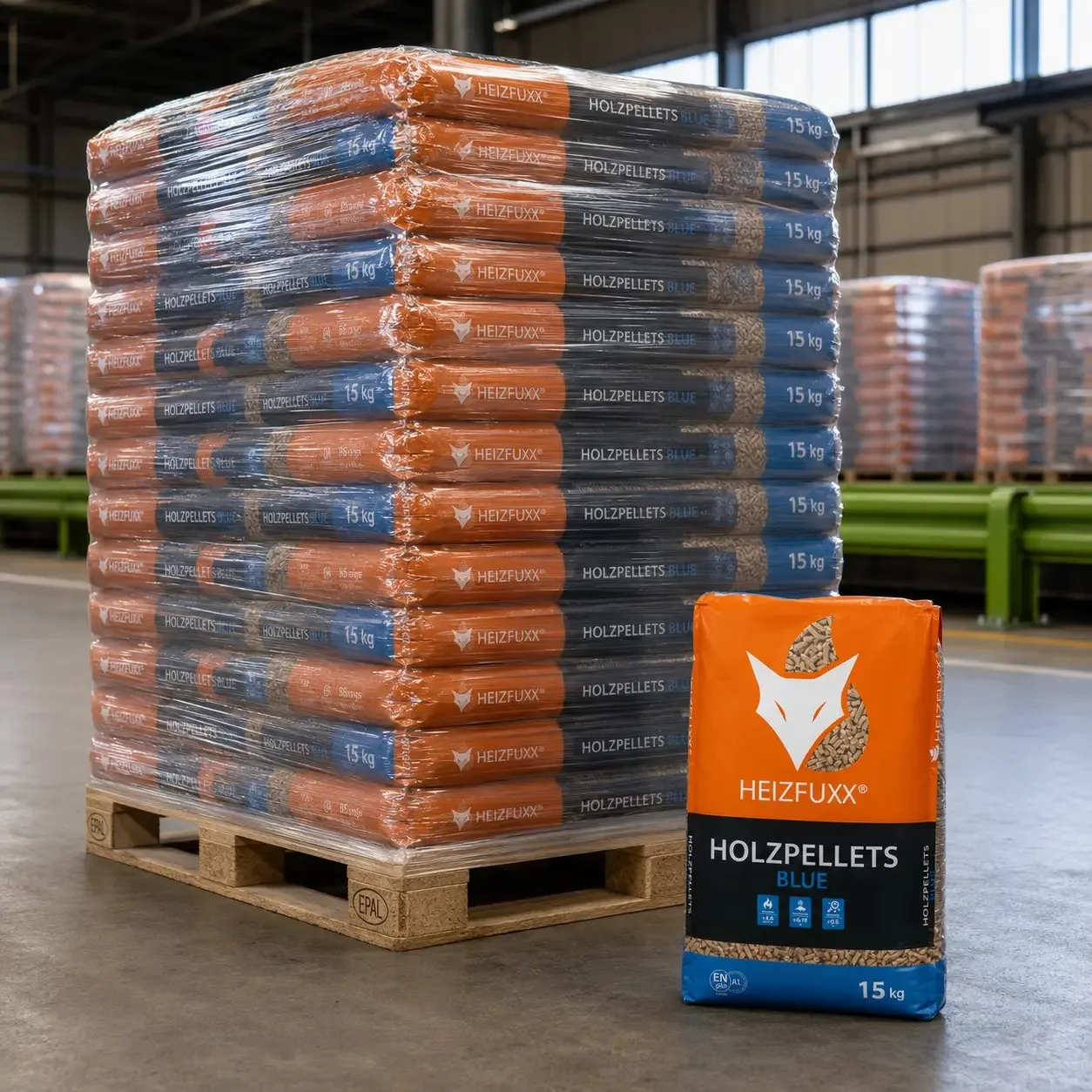
Ask a freight forwarder how many pallets fit on a trailer and you will be told 33. Ask how many pallets of wood pellets fit on a trailer and the honest answer is: fewer, and the number depends entirely on how your supplier builds the pallet.
This matters commercially. The gap between a well-planned pellet load and a poorly planned one is not a rounding error — it is routinely a fifth of the freight budget, and it is decided before anyone touches a forklift.
This guide sets out the arithmetic. It assumes you are buying bagged pellets on pallets for resale or commercial use, in Europe, by road.
Two limits, and only one of them usually bites
Every road load is constrained by two things at once: how much it weighs and how much deck it occupies. Whichever limit you reach first ends the load.
Weight. Under Council Directive 96/53/EC, the maximum authorised weight for a five- or six-axle articulated combination in international traffic is 40 tonnes. Certain combined-transport operations are allowed 44 tonnes. Subtract the tractor and trailer tare and a conventional long-distance unit is left with a payload in the region of 24 tonnes.
Space. A standard 13.6 m curtain-sided semi-trailer is roughly 2.45 m wide inside and about 2.6–2.7 m high. Euro pallets measure 1,200 × 800 mm, so three fit across the width (3 × 800 = 2,400 mm) and eleven rows fit along the length (11 × 1,200 = 13,200 mm). That is where the figure of 33 pallets comes from.
Why pellets hit the weight limit first
Thirty-three pallets of pellets would weigh well over 30 tonnes. The payload stops you at roughly 24.
So for this product the deck is never the binding constraint — the weighbridge is. You will almost always leave floor space empty, and the only question is how much.
That single fact reframes the purchasing conversation. Asking “how many pallets can I get on a truck” is the wrong question. The right one is “how many tonnes of pellets can I get under 24, and how much pallet am I paying to carry?”
Working out the number
Three steps, no guesswork.
Step 1: establish the gross pallet weight
The figure that matters is the gross weight — product plus the pallet underneath it. An EPAL Euro pallet weighs approximately 25 kg and has a safe working load of 1,500 kg, so a normal pellet pallet sits comfortably inside its structural rating.
Two configurations from our own catalogue, which we publish in full on every product page:
| Configuration | Bags | Product weight | + EPAL tare | Gross |
|---|---|---|---|---|
| Heizfuxx Holzpellets BLUE | 65 × 15 kg | 975 kg | ~25 kg | ~1,000 kg |
| ScandiWarm Economy | 50 × 15 kg | 750 kg | ~25 kg | ~775 kg |
Step 2: divide the payload by the gross pallet weight
Take 24,000 kg as a working payload — confirm the real figure with your carrier, because tractor and trailer tare vary.
- 1,000 kg pallets: 24,000 ÷ 1,000 = 24 pallets, carrying 23,400 kg of pellets
- 775 kg pallets: 24,000 ÷ 775 = 30.9, so 30 pallets, carrying 22,500 kg of pellets
Step 3: check it against the deck
Pallets load three across, so round down to a multiple of three where you can — a part row is wasted handling.
- 24 pallets = 8 rows = 9.6 m of a 13.6 m deck
- 30 pallets = 10 rows = 12.0 m of a 13.6 m deck
In the first case roughly 29% of the trailer floor travels empty. That is normal for this product and not a mistake. It is simply what a dense fuel does to a load plan.
Why pallet configuration changes your cost per tonne
Here is the part that is easy to miss, and it is worth real money.
Every kilogram of pallet is a kilogram of pellets you cannot carry. On a 1,000 kg pallet the EPAL is about 2.5% of the gross weight. On a 775 kg pallet the same 25 kg pallet is about 3.2%.
Follow it through to the load:
| 65 × 15 kg | 50 × 15 kg | |
|---|---|---|
| Pallets under 24 t | 24 | 30 |
| Pellets carried | 23,400 kg | 22,500 kg |
| Pallet tare carried | 600 kg | 750 kg |
| Handling units | 24 | 30 |
The heavier configuration moves roughly 900 kg more product on the same truck, for the same freight cost, with six fewer units to handle at both ends.
Because road freight is priced per load rather than per tonne, that difference lands directly on your cost per tonne — about 4% better on the product alone, before counting the labour saved on handling. Over a season’s buying it is not trivial.
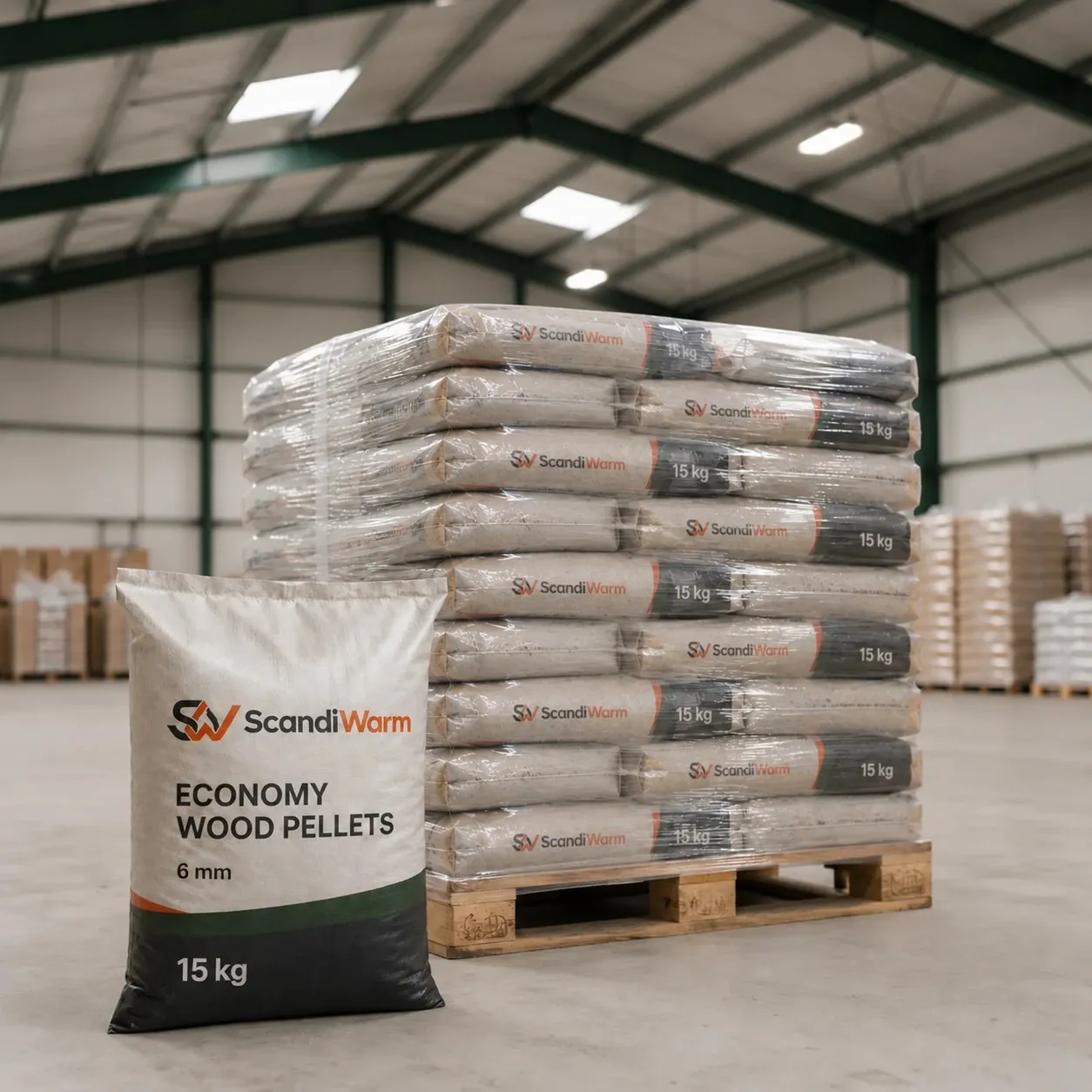
ScandiWarm Economy, supplied 50 bags to a pallet. Photograph of a product in our catalogue, not of a Premium Bio Pellet facility.
None of which makes the lighter pallet wrong. A 750 kg pallet is easier for a customer with a small forklift, and it suits retail sites that break pallets down for over-the-counter sales. The point is simply that the configuration is a commercial decision, not a detail — and it should be made deliberately rather than inherited from whatever the supplier happened to send.
Part loads, groupage and deck metres
Not every order is a full truck. If you are buying less, you are buying loading metres (LDM) rather than a vehicle.
A row of three Euro pallets occupies 1.2 m of deck, so one row is 1.2 LDM. Groupage pricing is usually quoted against whichever is greater: the deck metres you occupy, or your share of the payload by weight.
For pellets, the weight conversion almost always governs. A carrier typically applies a conversion factor to turn LDM into chargeable weight, and dense freight breaches it immediately. In practice:
- Under about 8 tonnes, groupage is usually cheaper.
- Above roughly 15 tonnes, a dedicated vehicle is usually cheaper per tonne, because you are already paying for most of it.
- Between the two, get both quoted. It genuinely varies by lane and season.
If you are new to a route, ask the carrier for the quote both ways on the same enquiry. It costs you one email and it is the cheapest piece of market research available.
What to confirm before you place the order
Most load-planning problems are information problems. Nine questions prevent nearly all of them:
- Bags per pallet and bag weight — gives you the product weight.
- Gross pallet weight — product plus pallet.
- Pallet type — EPAL exchange, one-way, or a non-standard footprint. This affects both the tare and whether you owe pallets back.
- Pallet height — determines whether a load can be double-stacked. Do not assume it can; confirm it.
- Wrapping — shrink-wrap is a moisture barrier as well as a handling aid, and pellets are hygroscopic.
- Payload of the vehicle actually assigned — 24 tonnes is a planning figure, not a promise.
- Incoterms — who arranges and pays for the leg, and where risk passes.
- Unloading capability at the delivery address — forklift, loading dock, or a tail-lift vehicle. A tail-lift reduces payload.
- Whether the product is certified, and to what class — not a freight question, but the one most often discovered too late. Our certifications page explains what the classes mean and how we publish them.
If a supplier cannot answer the first four from memory, that in itself tells you something.
A worked example
A distributor in Germany wants roughly 23 tonnes delivered, and is offered the same price per tonne on both configurations.
- Choosing 65 × 15 kg: 24 pallets, 23.4 t on one vehicle. One delivery, 24 units handled.
- Choosing 50 × 15 kg: they need 31 pallets for the same tonnage, which is 24.0 t gross — over the payload. So it becomes 30 pallets and 22.5 t on the first vehicle, and the balance waits for the next order or ships as expensive groupage.
Same price per tonne, same product class, materially different outcome — decided entirely by how the pallet was built.
Frequently asked questions
How many pallets of wood pellets fit in a 13.6 m trailer? Physically 33, but weight stops you long before that. At a 24-tonne payload, expect roughly 24 pallets at 1,000 kg gross or 30 at 775 kg gross.
Why is the trailer not full? Because pellets are dense. You reach the 40-tonne gross vehicle limit with a quarter to a third of the floor still empty. That is normal and not a planning error.
Can pellet pallets be double-stacked? Only if the pallet height allows it within the trailer’s internal height, and only if the wrapping and the lower pallet can take the load. An EPAL pallet’s safe working load is 1,500 kg, which is rarely the constraint; height usually is. Ask your supplier for the pallet height rather than assuming.
Is a heavier pallet always better? For freight efficiency, yes — less tare per tonne, fewer units to handle. For a customer with limited handling equipment or a retail site that splits pallets, no. Choose on how the product will actually be moved at the far end.
What is the difference between LDM and weight-based pricing? Loading metres measure the deck you occupy; weight pricing measures what you load. Carriers charge on whichever is greater. For pellets it is nearly always weight.
Does pallet configuration affect pellet quality? Not directly. What affects quality in transit is moisture and handling — intact shrink-wrap, dry storage, and as few re-stacks as possible. Our buyer’s guide to choosing premium wood pellets covers the specifications that determine quality in the first place.
Request a quote
Every product in our wood pellet catalogue publishes its bag count, pallet weight and full technical specification, so you can run these numbers before you contact anyone.
When you are ready, request a quotation with the product, the tonnage and the delivery location, and we will come back with pricing and availability. If you are unsure which pallet configuration suits your operation, say what equipment is available at the delivery address and we will tell you which of our products fits it.
Premium Bio Pellet Sp. z o.o. is a Polish wood-processing and wholesale company; our registered activities include the wholesale of timber and solid fuels, warehousing and road freight transport. Registration details are on our company page.