
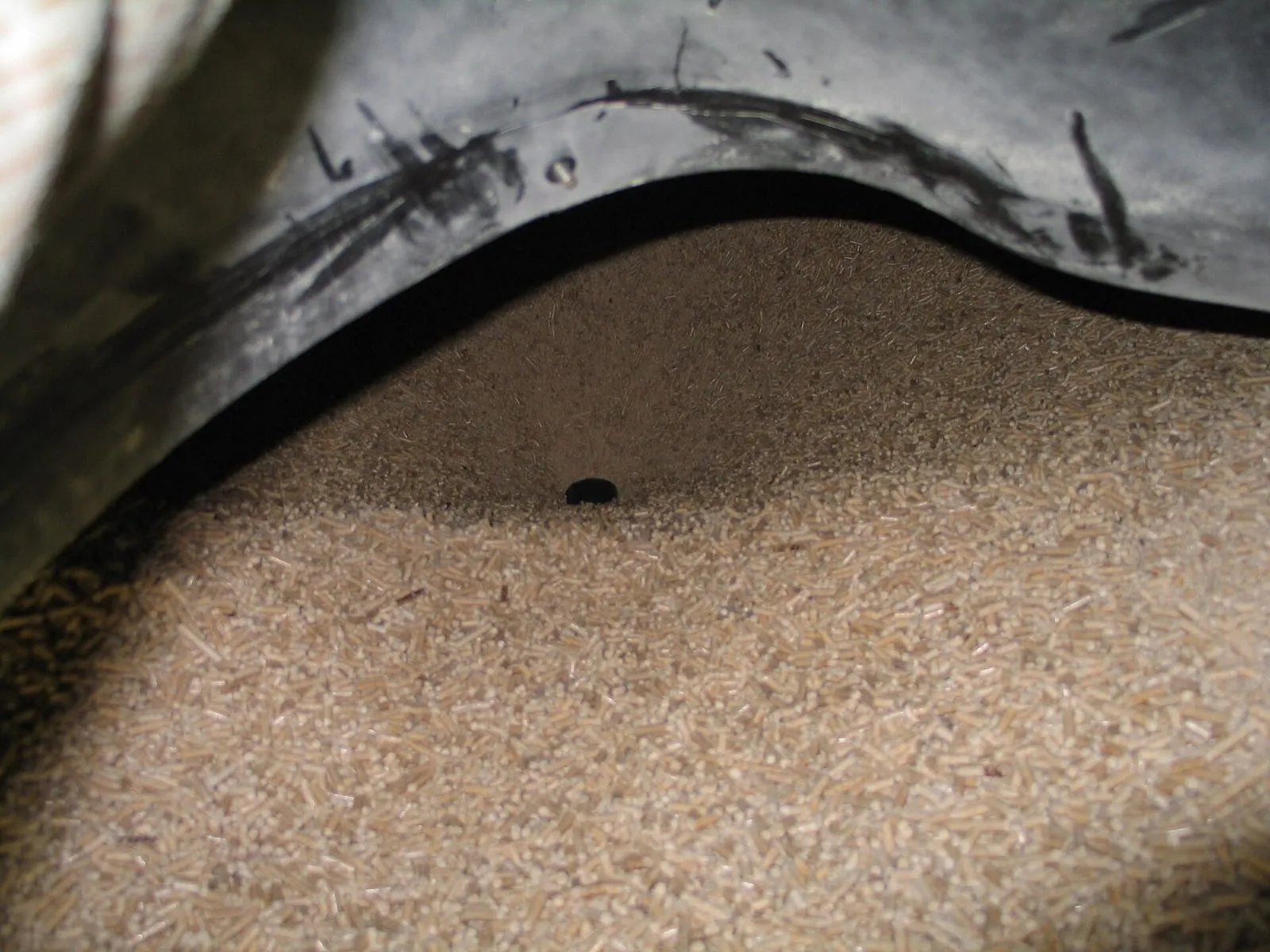

Every wholesale pellet buyer has had the call. A customer opens a bag and finds dust in the bottom; a silo delivery leaves a drift of powder across the floor; a pallet that looked fine on the truck turns out to be half fragments at the bottom of the shrink-wrap.
Fines are the most common quality complaint in pellet distribution and the least understood. They are also, unlike ash or calorific value, largely created after the pellet leaves the mill — which means a good deal of the problem sits with handling rather than with the producer.
This guide explains what fines are, what durability actually measures, where the dust really comes from, and what you can do about it. For the specifications themselves, our buyer’s guide to choosing premium wood pellets covers the figures in full.
What fines actually are
Fines are not a contaminant or a different material. They are the pellets themselves, abraded — loose dust and short broken fragments that have separated from whole pellets.
That matters commercially, because it changes who is responsible. Grit in a bag is a producer problem. Dust in a bag is usually a handling problem, and the handling may well have been yours.
Two separate figures describe the same underlying property:
- Fines — the dust present now, measured as a percentage of the sample.
- Mechanical durability — how much of a sample survives a standardised tumbling test intact. A prediction of how well the pellet will cope with handling to come.
A pellet can have low fines at dispatch and poor durability, in which case it will be dust by the time it reaches a customer. The reverse is also possible: a durable pellet that has simply been handled too many times.
Durability is a measurement, not a promise
The ENplus classes require a mechanical durability of at least 98.0% for A1 and 97.5% for A2. Those are laboratory figures from a tumbling test on a sample, and they tell you how the pellet behaves under a standardised beating.
They do not tell you how your particular load will arrive. Durability predicts resilience; it does not survive on your behalf. A 98% pellet transferred five times, blown thirty metres and re-stacked twice can easily arrive worse than a 97.5% pellet that went straight from pallet to store.
Treat durability as a selection criterion and fines as an acceptance criterion. They answer different questions.
Where the dust actually comes from
At the mill
Moisture content at pressing, die wear, cooling rate and raw material all determine how well a pellet holds together. A mill running a worn die or pressing slightly too dry produces pellets that are fine on day one and fragile thereafter. You cannot see this on arrival — it shows up two handling steps later.
This is a reason to buy consistently from a known product rather than on specification alone. A datasheet figure tells you about a sample; repeat purchase tells you about a mill.
In transit and at every transfer
This is where most fines are created, and it is cumulative.
Each time pellets are tipped, conveyed, dropped or re-stacked, a little more surface abrades away. Drop height matters disproportionately — pellets falling into an empty silo hit a hard floor, while the same pellets falling onto an existing bed are cushioned by it.
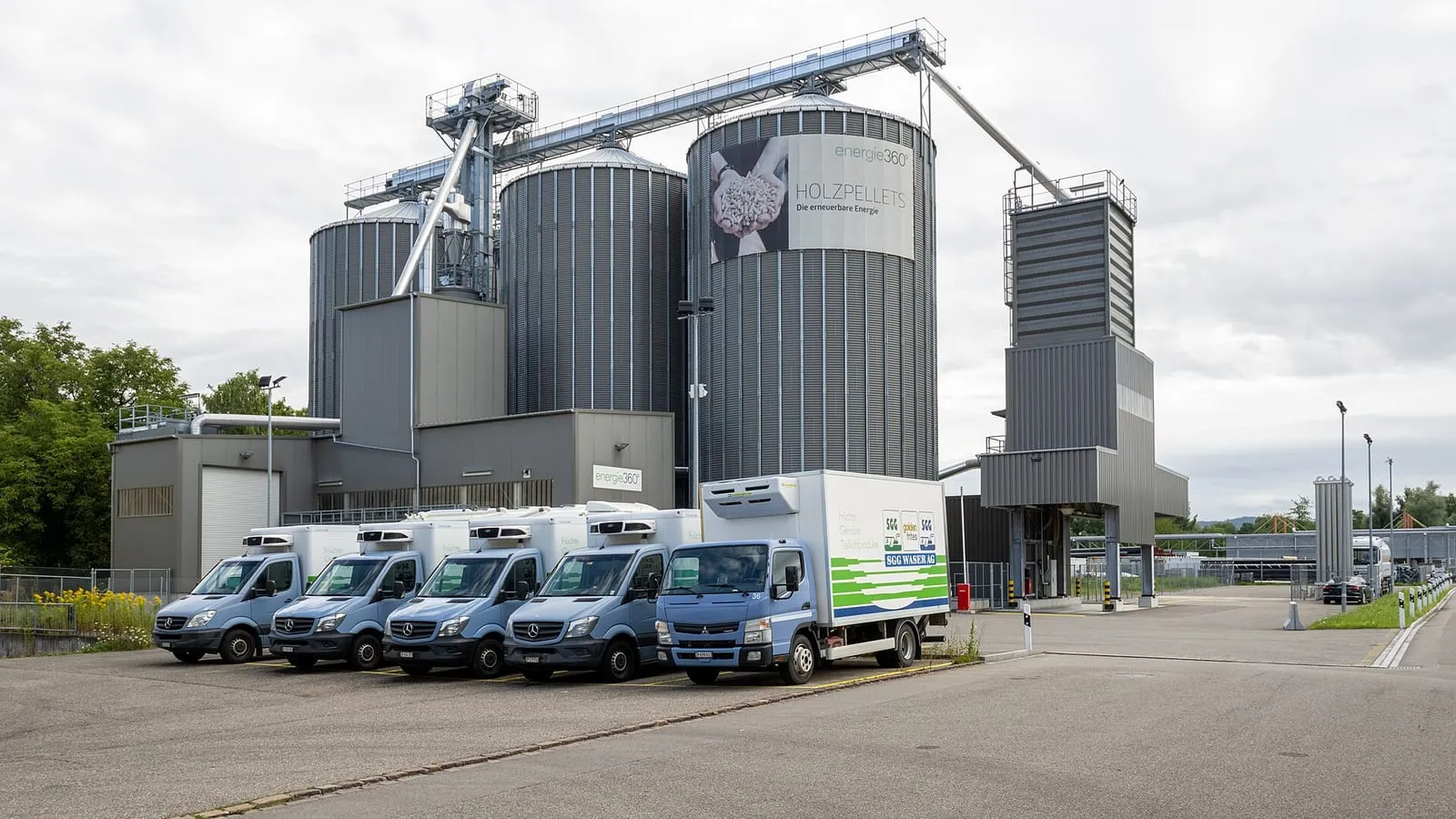
A pellet storage and transfer depot. Every conveyor, elevator and drop between the mill and the customer abrades the product a little further. Photograph: JoachimKohler-HB, Wikimedia Commons, CC BY-SA 4.0. The site shown belongs to a third party, not to Premium Bio Pellet.

A load that goes mill → pallet → your warehouse → customer has three handling events. The same load going mill → depot → regional store → your warehouse → customer has five, and will arrive measurably dustier for no other reason.
Pneumatic delivery
Blowing pellets through a hose is the hardest thing routinely done to them. Pressure, hose length and every bend all abrade the product, which is why blowing distance and pressure are specified in good bulk contracts rather than left to the driver’s judgement.
If you supply bulk and fines are a recurring complaint, the hose is the first place to look — before the producer.
What fines cost you
Dust is not just untidy.
In the appliance, fines burn differently from whole pellets. They can smother a burn pot, fall through grate holes unburnt, and accumulate as fine ash that fouls heat exchange surfaces faster. An auger designed for cylinders meters dust unevenly, which means inconsistent feed and inconsistent heat.
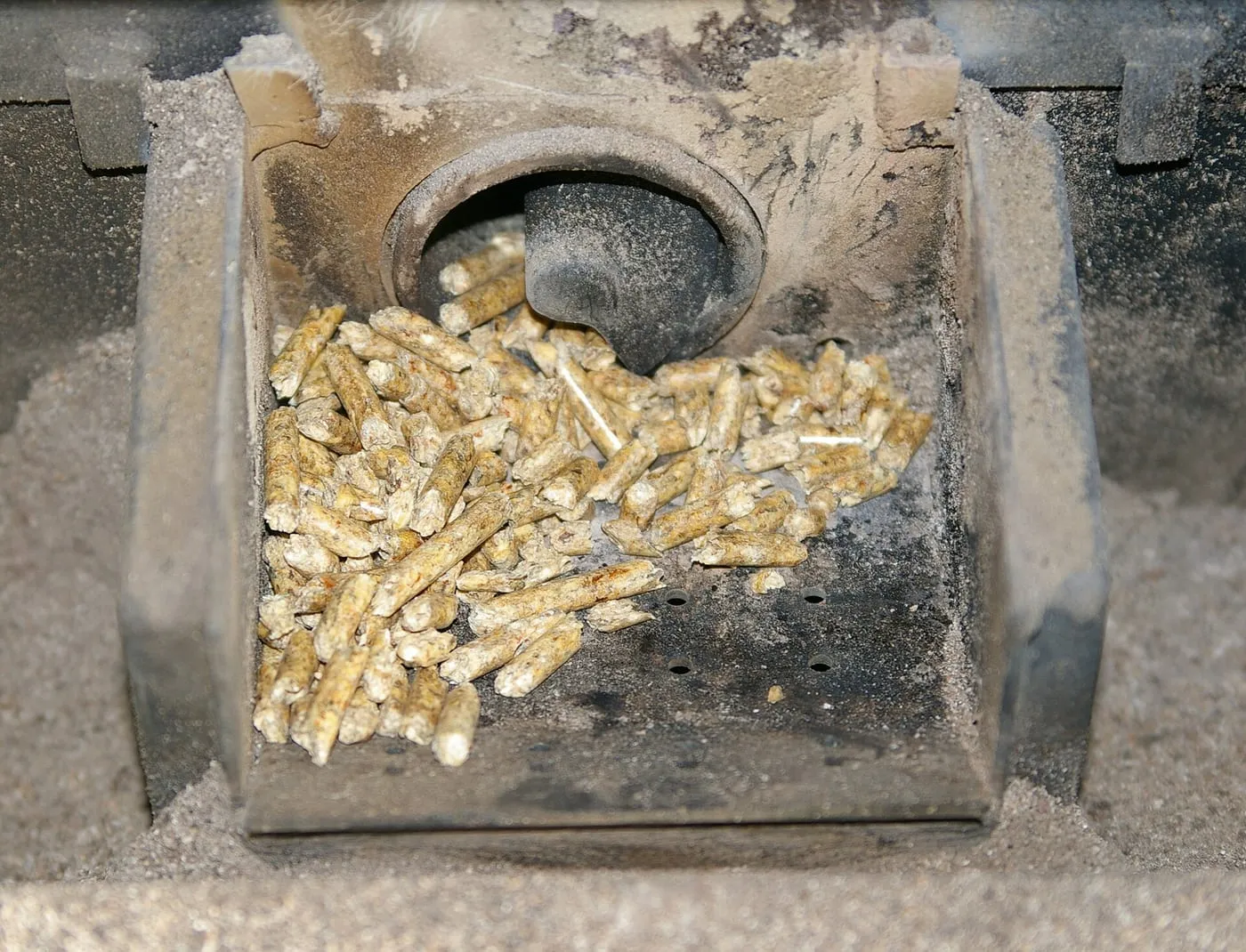
The burn pot of a pellet stove. Fines and ash accumulate here faster than whole pellets alone would produce. Photograph: Hustvedt, Wikimedia Commons, CC BY-SA 3.0. Illustrative.

In your warehouse, wood dust is a housekeeping and a safety matter. It settles on everything, and in sufficient concentration fine wood dust is combustible.
In your customer relationship, it is the complaint that costs most to resolve, because the product is already in their store and the evidence is already mixed into their stock.
Reducing fines in practice
Most of the available improvement is in handling, and most of it is free.
- Cut the number of transfers. Every link you remove between mill and customer removes a dust-generating step. Direct delivery beats cross-docking.
- Keep the shrink-wrap intact until the point of sale. It is a handling aid and a moisture barrier, and an unwrapped pallet sheds fragments every time it is touched.
- Limit drop height when filling a store, and fill onto an existing bed where you can rather than onto bare floor.
- Rotate stock. Oldest out first. Pellets do not improve in storage, and a pallet moved repeatedly to reach the one behind it has been handled for no commercial reason.
- Specify blowing distance and pressure for bulk deliveries rather than leaving it to the driver.
- Store off the ground and away from sweating walls. Moisture softens pellets, and softened pellets abrade faster.
If a delivery arrives dusty
Evidence beats argument, and it has to be gathered before the load is mixed into your stock.
- Photograph on arrival, before unloading — the pallets, the wrap, and any dust already loose in the vehicle.
- Take a sample and seal it, noting the date, the pallet it came from and the delivery reference. A retained sealed sample is worth more than any number of photographs.
- Record the delivery details: vehicle, driver, time, and the condition of the wrapping as it arrived.
- Report within the period your agreement specifies — and if your agreement does not specify one, that is the gap to close before the next order.
- Do not mix the load into existing stock until the question is settled. Once it is mixed, nobody can tell whose dust it is.
Our guide to planning a monthly supply agreement covers where to set these terms down before they are needed.
Quick checklist
- Durability stated on the specification, and the class it corresponds to
- Fines threshold agreed, with a sampling method and who takes the sample
- Number of handling steps between mill and your customer — count them
- Shrink-wrap condition recorded on arrival
- Drop height and blowing distance controlled where you fill bulk
- Stock rotation in place, oldest first
- Reporting window for a dust complaint written into the agreement
- A sealed retained sample from any disputed load
Request a quotation
Premium Bio Pellet Sp. z o.o. is a Polish wholesale distributor of pellets produced by third parties. Every product in our catalogue publishes the manufacturer’s technical specification in full, including mechanical durability where the specification states it — and we do not state a figure the specification does not declare.
Tell us the product, tonnage, packaging and destination and we will come back with what we can support.
Premium Bio Pellet Sp. z o.o. sales@premiumbiopellet.com · +48 503 926 656
Request a quotation · Compare published specifications · How certification works